There was a time when hearing the words, “The compressor failed,” made every HVAC contractor brace for an uncomfortable conversation.
For decades, the compressor was the heart of the system—and often the most expensive component to replace. A failed compressor meant difficult phone calls, expensive repairs, and customers wondering how something so costly could stop working long before they thought it should.
Now, I am not saying that the compressor is no longer the heart of the system. But for many of us learning the trade, it also represented the greatest financial risk inside the equipment. Protect the compressor, keep the refrigerant circuit healthy, and you’ve protected the biggest investment inside the unit.
But somewhere along the way, our industry changed.
Not overnight. Not because of one product launch or one efficiency standard. It happened gradually, one technological advancement at a time, until today’s equipment looks very little like the systems many of us learned on early in our careers.
Today, residential and commercial HVAC equipment is quieter, more efficient, more comfortable, and smarter than ever before. Systems communicate with thermostats, optimize performance, adjust capacity on the fly, and consume less energy while delivering greater comfort than previous generations ever could.
Those advancements have been tremendous for our customers.
They’ve also fundamentally changed the equipment we install.
Modern HVAC systems no longer depend solely on mechanical components. They increasingly depend on sophisticated electronics.
Variable-speed compressors, inverter drives, ECM motors, communicating controls, advanced circuit boards, pressure sensors, temperature sensors, and integrated logic have transformed what an HVAC system really is. In many ways, we’re no longer installing only a mechanical system that heats and cools a space.
We’re installing a computer that happens to move refrigerant.
That shift should also change the way we think about protecting the investment we install.
The average homeowner or business owner doesn’t realize how much technology now lives inside both the indoor and outdoor equipment. They understand higher efficiency ratings. They appreciate quieter operation. They enjoy more consistent comfort.
Customers don’t buy electronics when they replace their HVAC system. They buy comfort. It’s our job to understand that today, one depends on the other.
What they don’t see is the network of electronics quietly making all of those improvements possible.
Those electronics don’t care whether the disturbance came from a summer thunderstorm, a utility switching event, or fluctuations on the electrical grid that caused a low-voltage dropout or high-voltage spike. They only know they were exposed to conditions they weren’t designed to absorb.
When that happens, the repair conversation can become every bit as expensive—and often more frustrating—than replacing a compressor ever was.
As contractors, we spend a great deal of time discussing airflow, refrigerant charge, static pressure, combustion safety, duct design, and preventive maintenance because we know those things protect system performance over time. Why should protecting the electronics be viewed any differently?
Maybe that’s the conversation our industry needs to start having.
For years, surge protection has often been presented as another accessory on the proposal. Another box to check. Another line item that customers frequently decline because they don’t fully understand its purpose.
But perhaps we’ve been framing the conversation incorrectly.
Instead of asking customers if they’d like to purchase another accessory, maybe we should be explaining that we’re helping protect one of the largest mechanical investments they’ll make in their home or business.
That’s a completely different conversation.
Nobody questions protecting expensive televisions, computers, servers, or home entertainment systems from electrical surges. Yet the HVAC equipment serving that same home or building often represents an even larger investment—one that now contains thousands of dollars’ worth of sophisticated electronics designed to deliver comfort every single day.
Protecting that investment shouldn’t feel like an upsell.
It should feel like responsible system design.
The best contractors have always done more than replace equipment—they reduce risk. They recommend proper filtration because it protects airflow and system longevity. They address drainage because they know water damage can become far more expensive than a clogged drain. They verify airflow because efficiency means very little if the system can’t breathe.
Electrical protection belongs in that same category.
It’s not about selling another product.
It’s about recognizing that modern HVAC systems deserve modern protection.
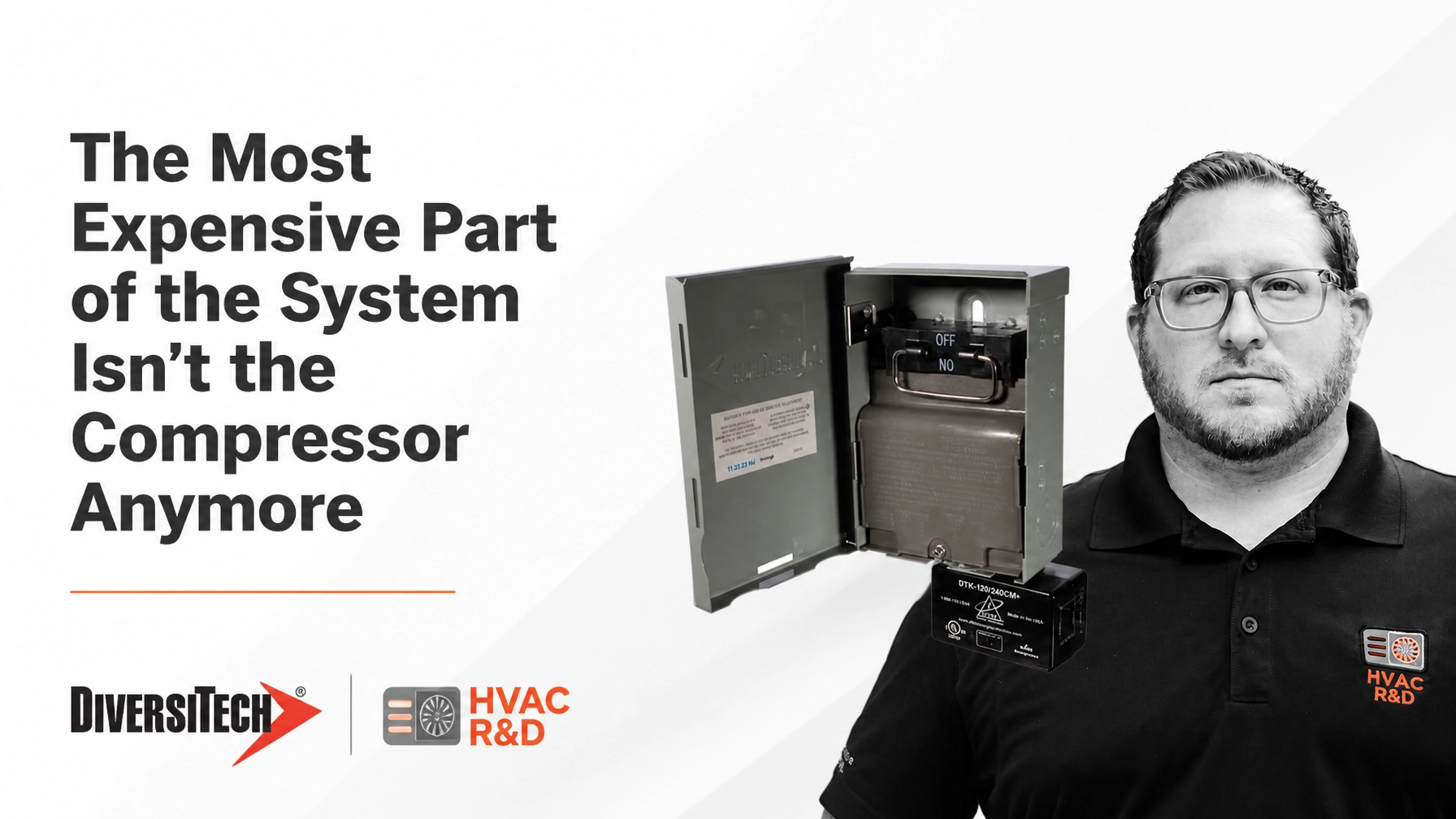
That’s exactly why DiversiTech Corporation‘s surge-protected disconnect fits into this conversation so naturally. Instead of treating surge protection as another optional accessory that may or may not be installed later, it integrates electrical protection into a component that’s already required for the installation. The value isn’t simply combining two functions into one enclosure. The value is reinforcing the idea that protecting today’s equipment should become part of the installation standard—not an afterthought.
Building that level of protection into the pricing structure for new installations and retrofit applications should become part of delivering a complete solution. It adds value for the customer, reduces unnecessary risk, and shifts the conversation away from selling another accessory toward protecting the investment you’ve been trusted to install.
Every generation of HVAC professionals has adapted to changing technology. We learned higher-efficiency equipment. We learned variable-speed systems. We’re continuing to learn communicating controls, connected homes, and increasingly intelligent HVAC platforms.
The next evolution isn’t simply understanding these systems.
It’s understanding how to protect them.
Because our job isn’t just installing HVAC equipment anymore.
Our job is protecting the investment our customers trusted us to put in their home or business.
Ramblin’ Rhyno, Out.
Peace Y’all.
To learn more about DiversiTech Corporation‘s fused and non-fused pre-wired surge-protected disconnects, visit the link accompanying this article or ask your local HVAC distributor about DiversiTech surge protection solutions.
This article is part of the HVAC R&D Podcast‘s Industry Partner Editorial Series, where we explore important topics shaping the skilled trades while highlighting products and solutions that support those conversations.